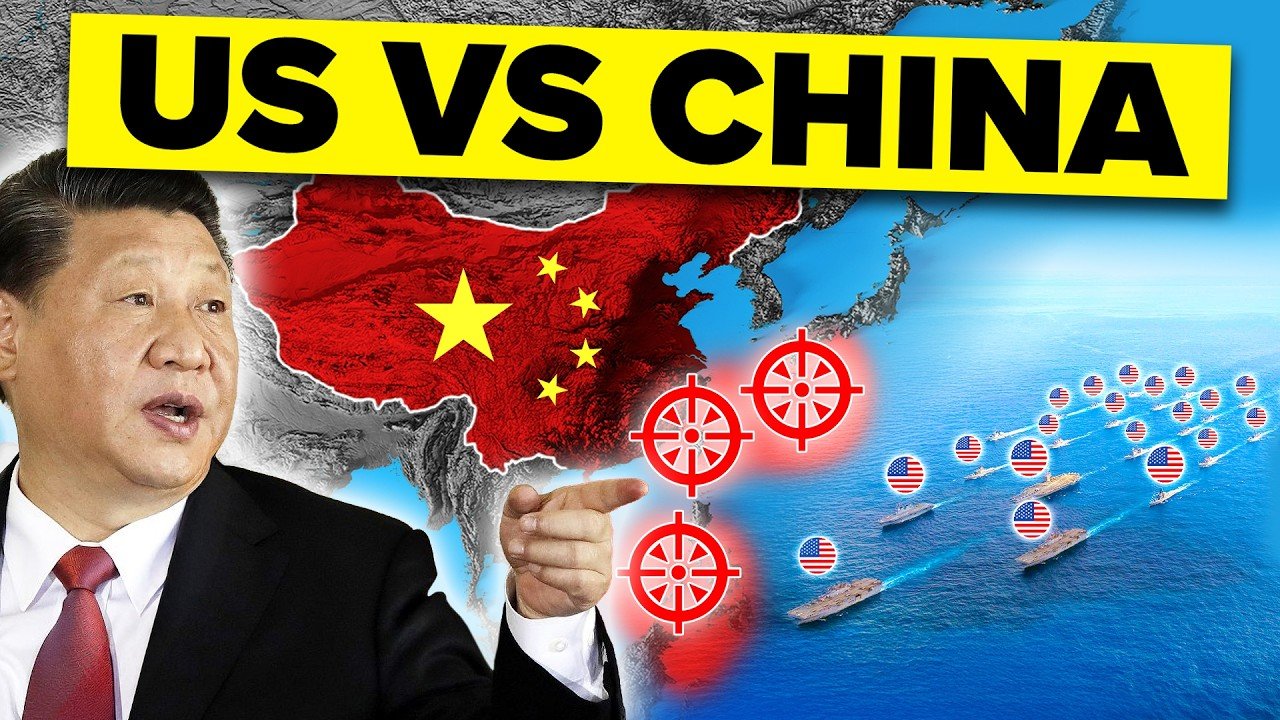
Relations between the United States and China have entered one of their most volatile phases in decades. Military encounters at sea and in the air are becoming more frequent, rhetoric is hardening on both sides, and diplomatic trust is fragile. While neither Washington nor Beijing appears to seek open conflict, the growing number of close calls raises a dangerous question: could a single miscalculation trigger a crisis that escalates faster than leaders can control?
This analysis examines the nature of recent military confrontations, the strategic pressure points driving risk, and why the current environment makes rapid escalation more likely than many policymakers publicly admit.
The Rise of Close Military Encounters
In recent years, US and Chinese forces have increasingly operated in close proximity, particularly in the South China Sea, the East China Sea, and the skies around Taiwan. Warships shadow each other, fighter jets intercept surveillance aircraft, and naval maneuvers are conducted at distances that leave little margin for error.
These encounters are not accidental. Both sides are deliberately asserting presence and signaling resolve. The United States emphasizes freedom of navigation and alliance commitments, while China seeks to defend what it considers its sovereign interests and strategic buffer zones. The result is a crowded and tense operating environment where misjudgment, mechanical failure, or human error could quickly spiral into confrontation.
Taiwan as the Central Flashpoint
Taiwan sits at the heart of US-China military tension. For Beijing, Taiwan is a core national interest tied to sovereignty and historical legitimacy. For Washington, Taiwan is a key partner whose security is linked to regional stability and the credibility of US commitments in Asia.
Chinese military drills around Taiwan have grown larger, more frequent, and more complex. Air and naval forces regularly cross median lines and simulate blockade or invasion scenarios. In response, the United States conducts transits, surveillance flights, and arms sales designed to deter aggression.
The problem is not just intent but timing. In a crisis, rapid military movements could be misinterpreted as preparation for attack, prompting preemptive actions. Escalation could occur even if neither side initially planned for war.
South China Sea and Regional Waters
Beyond Taiwan, the South China Sea represents another major pressure point. China’s expansive territorial claims overlap with those of several Southeast Asian nations, and the US Navy regularly conducts operations to challenge what it views as excessive maritime claims.
Encounters between US vessels and Chinese ships in these waters have involved dangerous maneuvers, including close passes and aggressive signaling. While such actions are often calibrated to avoid direct collision, the sheer frequency of encounters increases cumulative risk.
Regional actors are also drawn into this dynamic. Allies and partners may request US support, while China may view multinational exercises as containment efforts. This layered complexity increases the chances that a localized incident could widen into a broader confrontation.
Airspace Risks and Rapid Escalation
Aerial encounters are particularly dangerous due to speed and limited reaction time. Intercepts between fighter jets and surveillance aircraft can unfold in seconds, leaving little room for de-escalation once an incident begins.
History shows how quickly air incidents can escalate diplomatically and militarily. Even a non-lethal collision or forced landing could provoke nationalist outrage, domestic political pressure, and demands for retaliation. In today’s environment of social media and real-time reporting, leaders may have less flexibility to quietly defuse tensions.
Military Modernization and Doctrinal Shifts
Both the US and China are modernizing their militaries at a rapid pace. Advanced missiles, cyber capabilities, space assets, and artificial intelligence are reshaping how conflicts might unfold. These technologies compress decision-making timelines and increase the temptation to act quickly in a perceived crisis.
China’s emphasis on anti-access and area-denial capabilities aims to deter US intervention, while the US focuses on maintaining operational access and alliance coordination. Each side’s defensive measures can appear offensive to the other, reinforcing mistrust.
In such an environment, commanders may feel pressure to demonstrate resolve early, increasing the risk of escalation before diplomatic channels can be fully engaged.
Fragile Diplomatic Guardrails
Diplomatic communication between Washington and Beijing exists but remains fragile. While military hotlines and crisis-management mechanisms are in place, their effectiveness depends on political will and mutual trust, both of which are in short supply.
Periods of diplomatic freeze have coincided with spikes in military activity, reducing opportunities for clarification and reassurance. When communication breaks down, assumptions fill the gap, often in the most pessimistic direction.
Even when dialogue resumes, it may lag behind fast-moving events at sea or in the air, limiting its ability to prevent escalation once an incident occurs.
Domestic Politics and Nationalism
Internal political dynamics further complicate crisis management. In both countries, nationalism and public opinion can constrain leaders’ options. Any perceived concession may be portrayed as weakness, particularly during election cycles or leadership transitions.
Media coverage and political rhetoric can harden positions quickly. Leaders may feel compelled to respond forcefully to avoid domestic backlash, even if restraint would better serve long-term stability.
This political pressure can shorten decision windows and reduce the space for compromise at precisely the moment when calm deliberation is most needed.
Alliance Dynamics and Extended Risk
US alliances in the Indo-Pacific add another layer of complexity. Commitments to Japan, South Korea, the Philippines, and others mean that a US-China incident could rapidly involve multiple actors.
China may view allied coordination as encirclement, while allies may fear abandonment if the US appears hesitant. These perceptions can drive risk-taking behavior on all sides, increasing the likelihood that a bilateral incident becomes a multilateral crisis.
Why Miscalculation Is the Greatest Threat
The greatest danger in the current US-China military environment is not deliberate war but miscalculation. Assumptions about the other side’s intentions, combined with compressed timelines and heightened alert levels, create fertile ground for mistakes.
A collision, an accidental discharge, or an overreaction could trigger a chain of responses that leaders struggle to halt. Once forces are mobilized and national pride is engaged, de-escalation becomes politically and militarily challenging.
Conclusion
Rising US-China military confrontations represent one of the most serious risks to global stability today. Close calls at sea and in the air, unresolved disputes over Taiwan and regional waters, rapid military modernization, and fragile diplomacy all contribute to a volatile environment.
Avoiding escalation will require sustained communication, clearer rules of engagement, and a shared recognition that restraint serves both sides’ interests. Without these measures, the margin for error will continue to shrink, making the next close call potentially far more consequential than the last.